
Centralized Version Control Systems (CVCS) and Distributed Version Control Systems (DVCS) represent two distinct approaches to managing code history. CVCS relies on a single authoritative repository, making collaboration straightforward but dependent on constant server access. DVCS, on the other hand, empowers developers with full local copies of the repository, enabling offline work, faster branching, and more resilient workflows
VCS (Version Control System) broadly covers both Centralized (CVCS) like SVN and Distributed (DVCS) like Git; the key difference is storage: CVCS uses a single central server (requiring network for most actions), while DVCS gives each developer a full local copy of the repo, enabling offline work, faster local operations (commits, branching), and greater resilience as there’s no single point of failure, making DVCS more flexible and popular for modern development.
Centralized Version Control (CVCS)
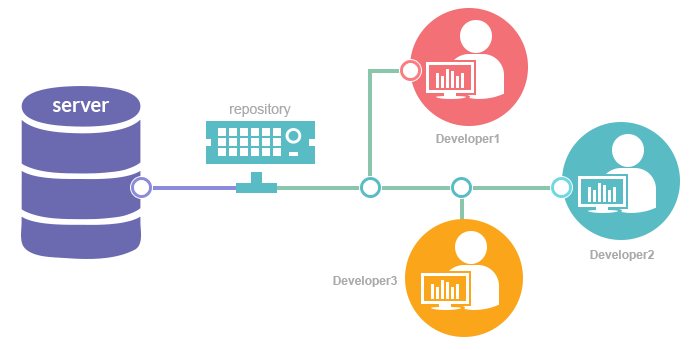
- How it works: All code and history live on one central server; developers “check out” files and commit changes back to it.
- Pros: Simpler access control, good for smaller teams.
- Cons: Requires network for most actions (commit, branch, merge), slow branching, single point of failure (server down = no work).
- Examples: Subversion (SVN), CVS.
Distributed Version Control (DVCS)
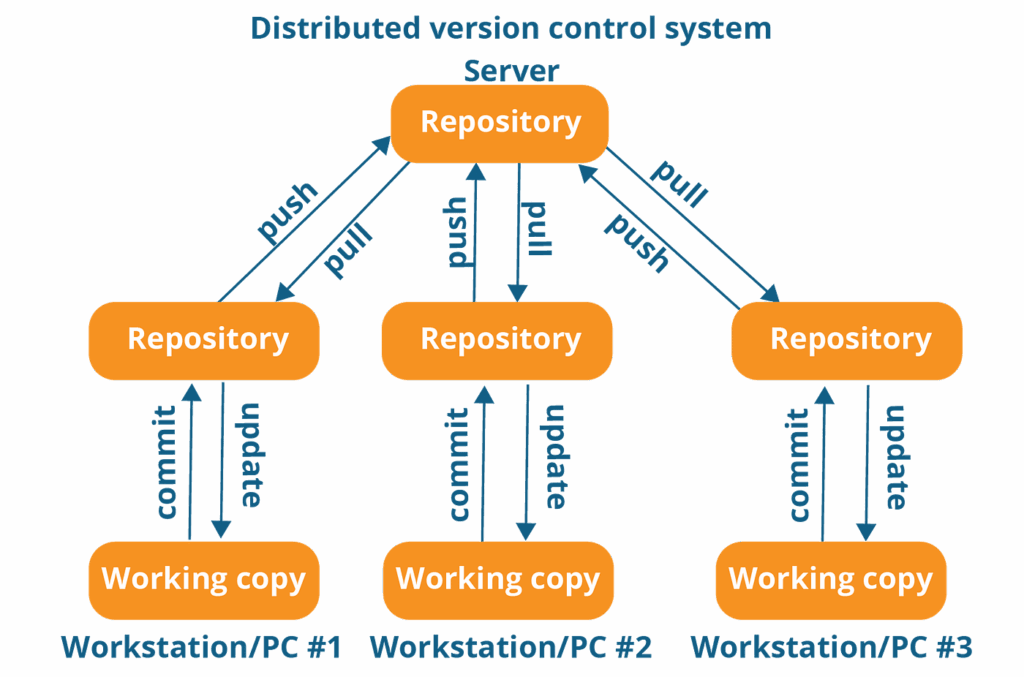
- How it works: Every developer gets a full copy (clone) of the entire repository, including history, on their local machine.
- Pros: Fast local operations (commit, branch, merge), work offline, no single point of failure, powerful branching/merging, flexible workflows.
- Cons: Slower initial clone (copies everything), uses more local storage, less built-in lock support for binary files.
- Examples: Git, Mercurial.
Key Differences & Why DVCS Wins
- Offline Capability: DVCS shines; CVCS struggles.
- Branching & Merging: DVCS makes it cheap, fast, and common; CVCS makes it heavy and server-dependent.
- Resilience: DVCS is robust (every copy is a backup); CVCS is fragile (server failure halts everything).
- Workflow: DVCS supports complex, independent workflows easily, while CVCS enforces a more linear, central flow.
- Speed: DVCS is much faster for most tasks as it mostly talks to the local disk, not a remote server.
